ATSC 3.0 interleaved with 5G Broadcast
One of the most interesting developments in the broadcast world right now is the coexistence of ATSC 3.0 and 5G Broadcast on the same RF channel. And it's already happening — making the right measurement tools essential.
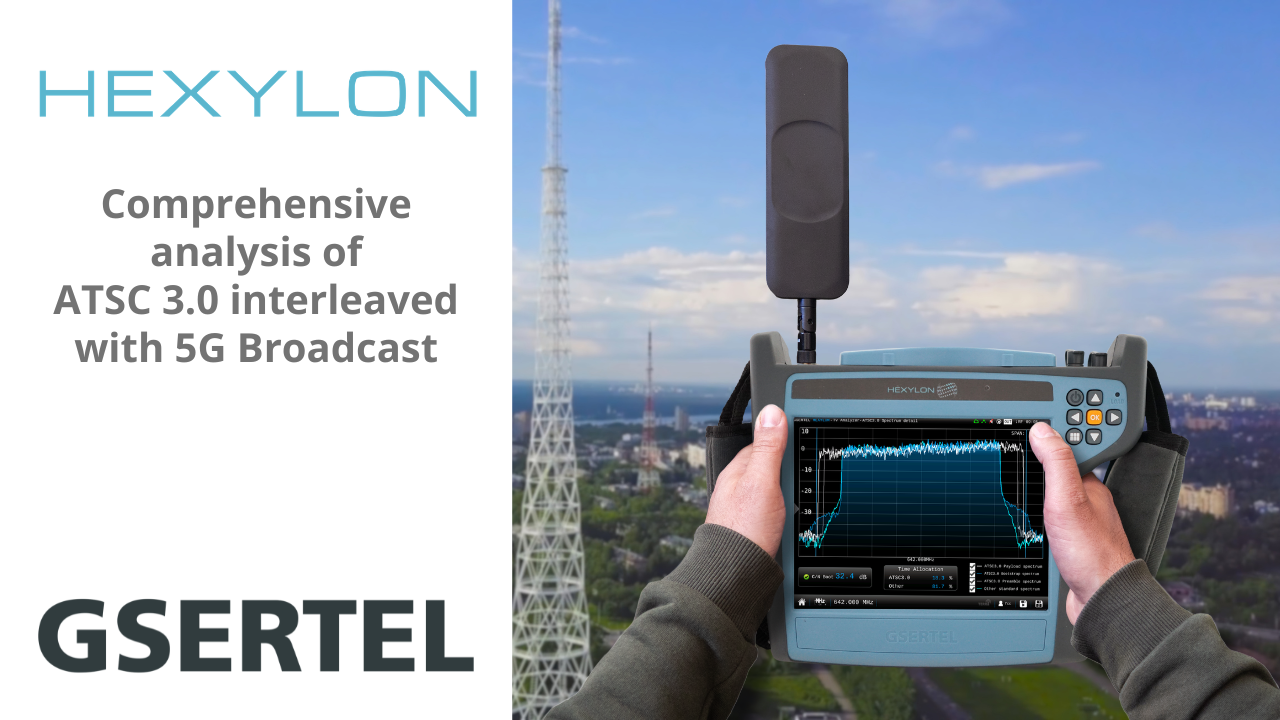
The ATSC 3.0 standard includes a mechanism — the min_time_to_next parameter — that creates controlled gaps in the ATSC 3.0 transmission. Those gaps can be used to insert 5G Broadcast bursts, enabling both signals to share the same spectrum without interference.
Companies like Castanet 5G are already building national 5G Broadcast networks, leveraging existing LPTV infrastructure to do so. And the business case is powerful: beyond traditional broadcasting, this technology opens the door to bypassing conventional unicast internet delivery — reducing latency, relieving network congestion, and cutting distribution costs for content owners and streaming services alike.
As of early 2026, real-world deployments are focusing on five key use cases, according to the IEEE blog:
- 4K/8K video for major sports events and concerts, with sub-second latency
- Fast, reliable public safety notifications that bypass congested cell towers during emergency situations
- Automotive updates, as well as real-time traffic and entertainment data delivered simultaneously to millions of vehicles
- Helps reduce the load on conventional cellular infrastructure and absorbs traffic spikes, so mobile operators aren't overwhelmed
- Access to educational content and virtual classrooms in areas where internet or mobile coverage simply doesn't reach
Deploying and verifying these hybrid transmissions requires the right measurement tools.
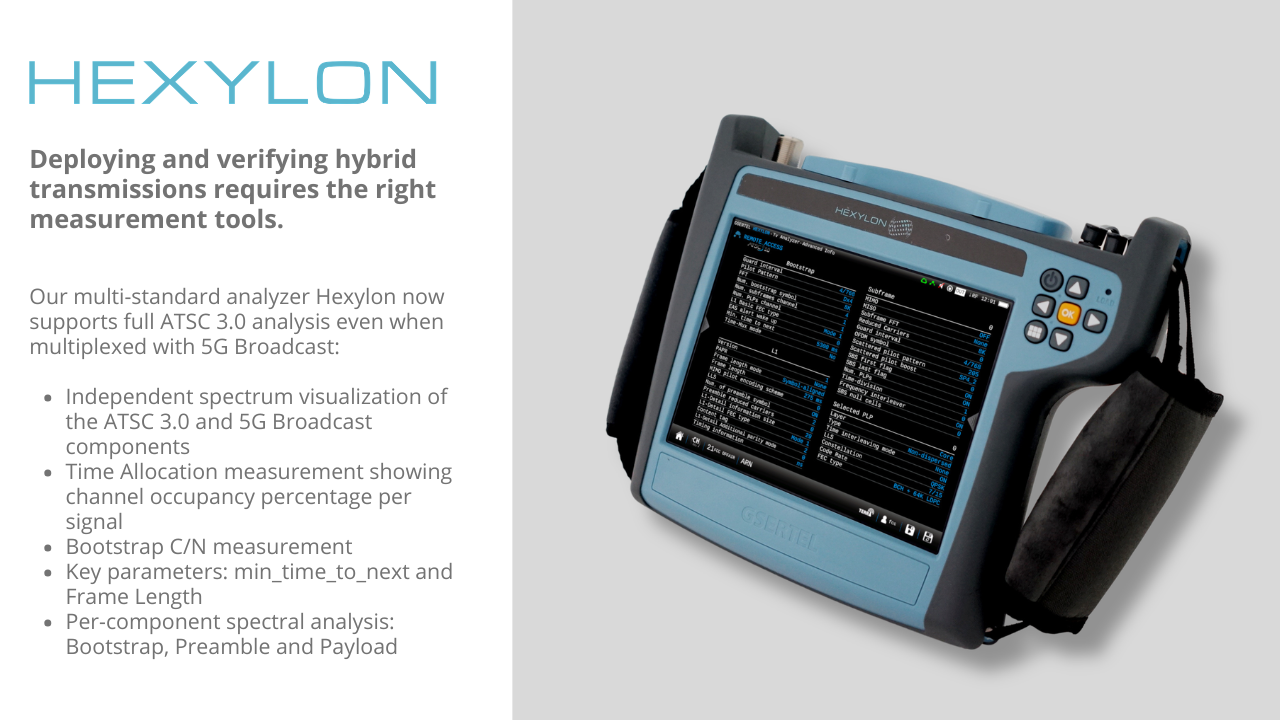
At Gsertel, we've done the development work to make it happen. Our multi-standard analyzer Hexylon now supports full ATSC 3.0 analysis even when multiplexed with 5G Broadcast — thanks to the new Time-Mux Mode, specifically designed for this type of transmission.
In a Time-Mux scenario, the ATSC 3.0 signal is not continuous — it comes in bursts, with idle intervals in between. Those same intervals are used by 5G Broadcast. Conventional analyzers struggle with this type of transmission: they lose synchronization, misread the signal, or simply fail to decode it correctly. Hexylon's Time-Mux Mode solves this by adapting its synchronization and demodulation process to detect the discontinuous time structure, maintain sync between bursts, and correctly analyze both active and inactive intervals.
With Time-Mux Mode enabled, Hexylon gives you:
- Independent spectrum visualization of the ATSC 3.0 and 5G Broadcast components
- Time Allocation measurement showing channel occupancy percentage per signal
- Bootstrap C/N measurement
- Key parameters: min_time_to_next and Frame Length
- Per-component spectral analysis: Bootstrap, Preamble and Payload
And this is a good example of how our instruments stay aligned with the latest technology demands: a simple software update, and the Hexylon you already have is ready to analyze these new hybrid transmissions.
The convergence of ATSC 3.0 and 5G Broadcast is no longer a roadmap item. Are your measurement tools ready for it?